155 GLM Replies Crossed Tenants. There Is No CVE.
155 GLM 5.3 replies held another tenant's cache, Cloudflare says. Restored 9 September. Public post 26 October. SGLang 0.5.22 is on PyPI. There is no CVE.
Pillar says Unsloth Studio ran repository code when a model was selected. The fix is 2026.6.9, verified in late June. No advisory was published.
Pillar Security said on 29 September that Unsloth Studio ran repository code when an operator selected a model to inspect it. That read ran before the weights loaded. Release 2026.6.9, verified in late June, is the fix. The maintainers published no advisory, so no CVE exists. Dark Reading reports no exploitation. Upgrade, then rotate tokens the process could read.
Pillar Security said on 29 September that Unsloth Studio executed repository code when an operator selected a model to inspect it. The weights never had to load. The fix has been in unsloth 2026.6.9 since late June. The maintainers declined to publish the advisory, so there is no CVE. The primary is Pillar's write-up. Dark Reading carried it the same day.
US X trends on 30 September were the Phillies and Gemini 4 Argon. Hacker News led with the launch. The control failure is the inspection path, and it is three months older than the post.
High High because a metadata read ran code as the user on a machine that typically holds tokens. Not because anyone has shown a campaign on this path.
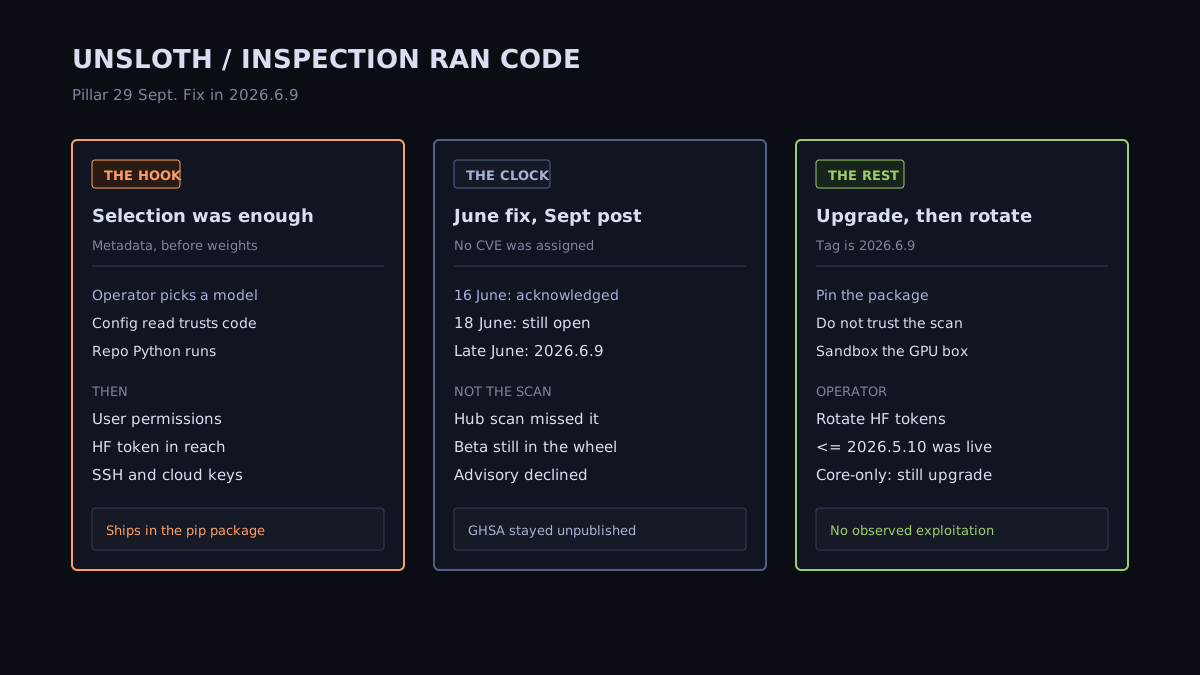
Unsloth is a widely used library for fine-tuning and quantizing models. Studio is its browser front end, marked beta. Pillar's point is that the beta label did not describe the install. The affected code shipped in the ordinary unsloth package. A normal pip install could deliver it without a prerelease flag.
The failure is the order of operations. Selecting a model made the backend fetch that repository's config and run custom code declared there, before any load, train, or export, and before the user's own remote-code choice was consulted. Pillar says the capability check defaulted to trusting remote code, including on a path that only needed to read declarative fields. Inspection was the trigger. Inference was not.
The code ran with the user's rights in the Studio backend process. On a fine-tune box that can mean training data, model artifacts, a Hugging Face token, and any SSH or cloud material that process could read. Pillar also names the wider case: a backend bound open to a network, a shared host, or a notebook session. The primary case does not need that. A logged-in operator selecting a repository they do not control is enough.
Pillar puts the defect in a 2026 family with the same shape. LMDeploy CVE-2026-46432, vLLM CVE-2026-4944, and InstructLab CVE-2026-6859 are all cases of a tool trusting remote code on the operator's behalf. Unsloth has no CVE of its own, because the advisory was not published. The family still tells you where to look: any helper that enables remote code during a step the user thinks is a read.
Ariel Fogel told Dark Reading that Pillar has seen no evidence of exploitation of this path, and no malicious repositories aimed at this configuration in particular. Other campaigns have used malicious models on the Hub. That is a different fact. Do not promote this write-up into a live intrusion report.
The package clock is the tag Pillar retested, not the day the mail started.
Early June: Pillar reported the issue privately, with a proposed fix, under an advisory the maintainers later declined to publish. Pillar names that draft GHSA-pc2m-72c4-r38q. On 16 June the maintainers acknowledged and started a broader hardening pass. On 18 June Pillar retested the then-current build and the issue was still present. On 23 June the maintainers asked for a tighter advisory and another check. Late June: Pillar verified the fix in 2026.6.9. Both the Hub path and the local-directory path were closed. Studio no longer loads arbitrary Hub models on that inspection path, and it no longer trusts remote code from local model files either. The maintainers then declined to publish. No CVE was assigned.
The disclosure clock is 29 September, the day Pillar published anyway. Between the verified tag and the public sentence, anyone on 2026.5.10 or earlier had a fixed release available and no advisory to search for. That is the same shape as OpenCode's month-late GHSA, with one harder edge: there is still no GHSA page to match.
Pillar's own summary line says a fix shipped on 18 June. The timeline in the same post says the 18 June retest still reproduced the bug. Use the timeline. The operator tag is 2026.6.9.
It is not a poisoned unsloth release. Nobody swapped the package for an implant. The maintainer account was not the story. The story is a default that treated a model repository as data during a step that executed code. Compare that with MemTensor, where the package itself was the implant. Different clock, different response. Here you upgrade a real fix. You do not yank a hijacked publisher.
It is not a Hugging Face outage and not a reason to ban remote code for every model. Pillar is clear that legitimate models still need that feature, and that the Hub cannot know which downstream tool will enable it. The decision belongs in Studio, and from 2026.6.9 the inspection path no longer makes it for you.
It is not a confirmed intrusion. No campaign count, no victim list, no evidence in the write-up or in Dark Reading's follow-up. The impact clock that is still open is local: hosts that selected an untrusted repository before the upgrade, and tokens those processes could see.
It is also not limited to people who thought they were running a beta. The code was in the general package. If your install docs never mention Studio, check whether anyone launched it anyway.
If you fine-tune with Unsloth, or you ship a image that includes it:
The launch on the front page today is a new model. The package clock on this one already ran. The missing piece was the sentence, and it arrived on 29 September without an identifier most scanners accept.
No. Pillar says the maintainers declined to publish the advisory because Studio was marked beta, so no CVE was assigned. The vulnerable code still shipped in the standard unsloth package on PyPI. A scanner that only ingests CVE identifiers will not page this. The version boundary is 2026.6.9.
Pillar says the inspection path does not run unless Studio launches. The same pip package still carried the code. Upgrade anyway, then confirm no wrapper or desktop build is pinning an older copy. Core-only use lowers the trigger. It does not retire the wheel.
Pillar says no, and that its own demonstration repository was not flagged. The scan is a best-effort blocklist aimed at known-bad serialization. Code that looks harmless in the repo and fetches work later is outside that job. The boundary sits in the tool that chose to run repository code during a metadata read.
If Studio on 2026.5.10 or earlier selected a repository you do not control, treat the process as having had the user's rights. Rotate the Hugging Face token and any cloud or SSH material that account could read. Pillar and Dark Reading both say they have no evidence this path was used in the wild. Rotation is the cost of an untrusted selection, not a confirmed theft.
155 GLM 5.3 replies held another tenant's cache, Cloudflare says. Restored 9 September. Public post 26 October. SGLang 0.5.22 is on PyPI. There is no CVE.
Qwen3.8-Flash-Next tried to upload after its reasoning said no tools. Cohere's sandbox blocked it. Under one eval call in 100,000. No CVE and no weight hash.
A Downloads instruction file sent Codex toward function-color. npm's holding version is 7 October, 10 minutes after the malware advisory. There is no agent CVE.