MemTensor's Latest Tag Was the Implant. Clean Builds Lasted Minutes.
On 23 September MemTensor's OpenClaw plugin and MemoryOS shipped a token stealer. Clean builds lasted minutes. Pulling the versions did not end the impact clock.
TypeSafe's Jev is a cheap typed gate for agents. Screen tool calls and injected context. Type safety is not a deny. Adversarial state can still move the answer.
TypeSafe launched Jev on 15 September as a System One decision model: state in, Choice, Score, or yes-or-no probability out. Security teams can put it on every tool call, retrieved passage, and agent trace. It cannot invent an option outside the schema. It can still pick the wrong option, including under injected text. Code owns the allowlist. Jev advises.
Hacker News spent today arguing OpenJev clones. US X News spent the weekend on TypeSafe's launch. Google still surfaces the speed claims. The operator question is narrower: can a 70-millisecond typed answer sit in front of a tool call without becoming the only lock.
Info A cheap gate for every agent step. Info because this is a control you can add, not a CVE you can file.
Diogo Almeida launched Jev on 15 September. Access opened without a waitlist on 20 September. TechCrunch put the InstructGPT and RLHF history on the record. Vercel put it on AI Gateway the next day. Tom's Hardware is still carrying the 193x and 445x homepage numbers.
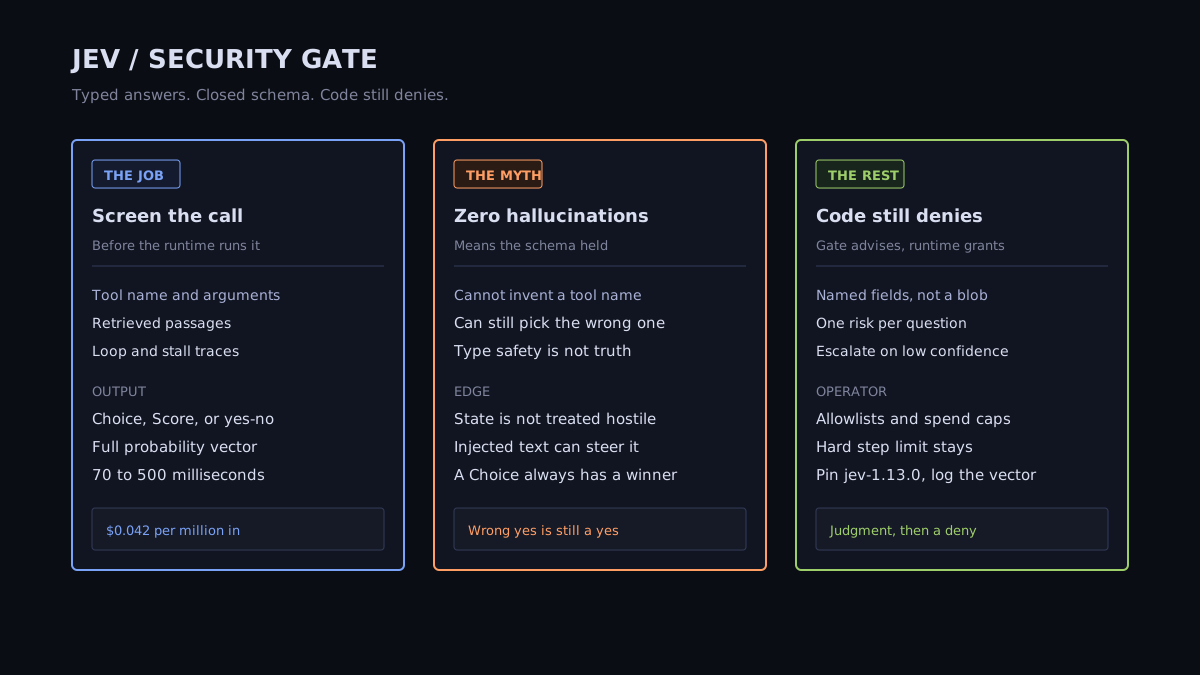
The contract is small. You send state and a map of questions. Each question is a Choice over a closed set, a Score on an ordered rubric, or a yes-or-no probability TypeSafe calls a Noul. Jev evaluates the questions in parallel. It returns typed values and a distribution. It does not write a paragraph. TypeSafe prices input at $0.042 per million tokens and does not charge for output.
The launch post calls this a frontier-intelligence function call, and it markets zero hallucinations. The footnote in TypeSafe's own nuance is the ticket: that number is schema matching, not empirical accuracy. A hallucinated tool name is impossible if the name was never in the list. A wrong listed name is still in bounds.
TypeSafe trains with a method it names Reinforcement Learning for Calibrated Decisions. As of this week there is no paper, no curves, and no public reproduction. Treat calibration as a claim you measure on your own labels before you set a threshold.
The useful jobs are the ones a coding agent already does badly at speed.
Screen the proposed tool call before the runtime runs it. Learn Jev and Vercel's eve helper do this as a cheap second opinion: destructive, outside scope, reversible, blast radius. Ask one risk per question so code can see which check failed. Escalate when confidence about scope is low, even if the picked label looks safe. Unsure is a first-class stop.
Screen retrieved passages and file contents before a planner reads them. A yes-or-no per passage can drop injected instructions from a RAG stack. That is not a prompt-injection patch. It is a filter you can afford on every hop.
Grade the trace. Looping, no progress, goal already met. Fast enough to run every step. Keep a hard step limit in code anyway. The model is watching a trace the agent wrote.
Route the uncertain case to a person. High confidence, act. Medium, confirm. Low, stop. Set each band from the cost of a wrong yes, not as one global number. A read can run cooler than a refund or a shell.
Pass tool name and arguments as named fields. Do not concatenate attacker-reachable text into the question. Filter the state in code first. jev-1.13 loses accuracy when the state is padded with unrelated detail, and it cannot count or do date math. Those belong in the runtime.
It is not a sandbox. Heapjack showed a Codex deny that lived in the same heap as the agent. Jev sitting in the harness is still a judgment the attacker can try to steer. Put the gate in front of the call. Keep the process isolation in a layer the model cannot read.
It is not Plugin4Shell. A pin that does not verify the checkout is a different ticket. Jev cannot see a swapped tree unless you send it the bytes.
It is also not a planner and not a writer. If you need an explanation, you wanted a chat model. If you need a path allowlist, you wanted code.
If you run agents that call tools, fetch pages, or install skills:
jev-1.13.0 or the version you measured. jev-latest moves. Thresholds tuned on one build can drift on the next. Re-run the set before you upgrade.The cheap part is real. You can afford a judgment on every step. The dangerous part is treating that judgment as the deny. Jev cannot invent a tool. Your code still has to be allowed to say no.
No. Jev does not write, plan, or execute. A generative model still drafts the turn. Jev judges a state you assembled. Vercel eve and LangChain middleware use it to pause a tool call. The agent is still the thing that proposed the call.
No. TypeSafe's number is schema matching: Jev cannot return an option you did not declare. It can return the wrong declared option, sometimes with high confidence. On Hacker News, Almeida agreed that type safety is not factual correctness. File the claim as a closed answer space, not as a correct deny.
No. TypeSafe's own jaggedness note says adversarial content can steer jev-1.13, and that state is not treated as hostile. Learn Jev's harness guide is explicit: the gate advises, the runtime enforces. Permissions, path allowlists, and spend caps stay in code. Escalate when confidence is low.
Heapjack showed a Codex deny that lived in the same process as the agent. Plugin4Shell showed a pin that did not verify the checkout. Jev is a judgment you can afford to run on every step. It does not move the deny outside the agent. Put Jev in front of the call. Keep the sandbox and the pin in a layer the model cannot rewrite.
On 23 September MemTensor's OpenClaw plugin and MemoryOS shipped a token stealer. Clean builds lasted minutes. Pulling the versions did not end the impact clock.
On 18 June an OpenAI research agent wrote files on a Medicare statistics portal. The 10 September notice went to a public mailbox. No patient record is known.
Accomplish found two Codex sandbox escapes. Heapjack ran host commands from read-only. Overpatch wrote outside the workspace. OpenAI fixed both in eight days.