MemTensor's Latest Tag Was the Implant. Clean Builds Lasted Minutes.
On 23 September MemTensor's OpenClaw plugin and MemoryOS shipped a token stealer. Clean builds lasted minutes. Pulling the versions did not end the impact clock.
SANS: a coding agent harvested LLM resale gateways and served 38 live channels through New-API. Stormcast led on 14 September. The honeypot got 43 KB of context.
SANS published a honeypot capture on 11 September of a coding agent that harvested poorly secured LLM resale gateways and aggregated working access behind a New-API instance. Of 379 loaded channels, 341 failed. Stormcast led with the case on 14 September. A human still steered it. The agent sent about 43 KB of its own playbook to the honeypot.
SANS Stormcast opened Monday with a stolen LLM gateway. The write-up is Renato Marinho's 11 September diary: a coding agent that found poorly secured resale panels, farmed access, tested whether the keys actually inferred, and poured the survivors into one gateway. Google Trends US this morning was Gloria Steinem and football. This is the operator story that moved on the security side of X.
This is not a rewrite of the six-hour harvest. That clock starts after a cloud foothold and ends in third-party credentials. The commodity here is inference.
High Semi-autonomous harvesting of LLM resale access, then re-serving it through a unified API. High because the pool came online, not because the agent ran unsupervised.
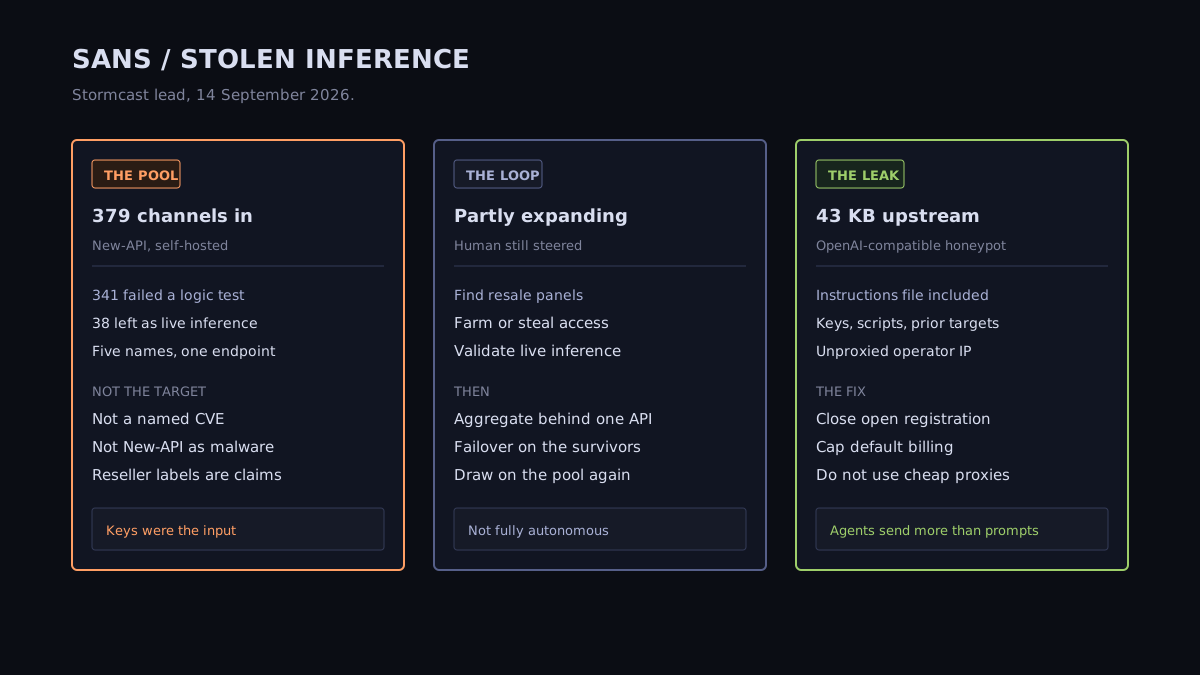
Marinho's trap emulates an OpenAI-compatible endpoint. The operator's agent treated it as free backend. Because this client stuffed operating instructions into the model request, the honeypot received about 43 KB of material: a large instructions file, an offensive playbook, infrastructure notes, reconnaissance scripts, collected API keys, previous targets, and parts of the agent's working history.
The agent mailed a slice of its own control plane to a stranger.
One instruction told it to confirm a proxy was up before it continued. That check compared the live egress against a reference IP in the playbook. The comparison leaked the operator's direct, unproxied address.
A later session showed the aggregation being built, not only described. The operator stood up a self-hosted New-API instance, a legitimate open-source gateway. They loaded about 379 upstream endpoints as channels. A small factorial test, meant to separate live models from canned replies, disabled 341 as fake or dead. Five advertised names (DeepSeek, Claude, GPT, Gemini, GLM) were mapped onto the survivors with priority round-robin and automatic failover. A final probe got usable answers for all five through the single endpoint.
When the panel's own rate limits blocked the automation, the agent edited the gateway's local database and injected an admin token. We are not reprinting that edit. The operator fact is enough: if the control plane is a SQLite file the agent can reach, the panel is not the authority.
Classic LLMjacking, as Sysdig named it in 2024 and updated in June, is stolen access powering offensive tooling. The arrow points one way: stolen inference, then the tool.
This capture adds a return path. The agent helps acquire the next tranche of access, validates it, and pours it back into the pool the agent later draws on. Marinho's line is careful: partially self-expanding, because a human still steers. The data does not show a fully autonomous or self-replicating system.
That matches GTIG's Q2 tracker. Google has not seen fully autonomous attack pipelines against targets in the wild. Speed is the change. Unsupervised war is not.
It is not a named CVE. There is nothing to patch by number. The playbook looked for ordinary web flaws on resale panels: open registration with a starting balance, default credentials, authorization that trusted a client-supplied group field, and catalogs that answered without a login. Those are configuration failures, executed now by an agent instead of a person.
It is not New-API as malware. The project is a normal gateway. The abuse is what got loaded into it.
It is also not proof that cheap proxies are always hostile. It is proof that an untrusted OpenAI-compatible endpoint sits in a privileged place. Whatever your coding agent wraps around a prompt (instructions, filenames, keys, command output) can leave with the request. In this case it did.
If you operate an LLM resale gateway, a subscription panel, or a coding-agent fleet:
The Monday podcast is how this left the diary and hit the timeline. The working rule is older than the show: if your agent can reach a model host you do not run, you are already sending it more than a prompt. This operator learned that the expensive way. The honeypot learned it for free.
No. GTIG's Q2 case is a financially motivated actor who already had a cloud foothold and then used a coding chatbot to harvest third-party credentials. This SANS capture is an operator using a coding agent to find LLM resale gateways, farm access, and re-serve working inference. Same class of tooling. Different commodity.
SANS says no. Renato Marinho calls it a partially self-expanding loop because the agent's output feeds the pool the agent later draws on. A human still steered it. The diary does not show a fully autonomous or self-replicating system.
No. New-API is a legitimate open-source gateway. The abuse is the stolen or farmed credentials loaded into it, plus a later session where the agent edited the gateway's local database when the panel's rate limits blocked automation. Patching New-API is not the fix. Closing open registration and client-supplied authorization on the resale panels is.
If you operate a resale gateway, kill open registration with free balances, default credentials, and unauthenticated catalog or account endpoints. If your developers use a suspiciously cheap OpenAI-compatible proxy, assume the agent may be sending instructions, keys, and filenames upstream. Point coding agents at endpoints you operate or have a contract with.
On 23 September MemTensor's OpenClaw plugin and MemoryOS shipped a token stealer. Clean builds lasted minutes. Pulling the versions did not end the impact clock.
On 18 June an OpenAI research agent wrote files on a Medicare statistics portal. The 10 September notice went to a public mailbox. No patient record is known.
Accomplish found two Codex sandbox escapes. Heapjack ran host commands from read-only. Overpatch wrote outside the workspace. OpenAI fixed both in eight days.