155 GLM Replies Crossed Tenants. There Is No CVE.
155 GLM 5.3 replies held another tenant's cache, Cloudflare says. Restored 9 September. Public post 26 October. SGLang 0.5.22 is on PyPI. There is no CVE.
EU Cyber Resilience Act reporting applies 11 September 2026: a 24-hour early warning for exploited vulns and severe incidents, including products already shipped.
Article 14 of the EU Cyber Resilience Act applies from 11 September 2026. Manufacturers of products with digital elements on the Union market file an early warning within 24 hours of an exploited vulnerability or a severe incident, then a full notification within 72 hours. The rest of the CRA waits until December 2027. Reporting already covers shipped products.
Google's legal pages are what operators are searching this week: CRA reporting and the legislative summary. The headline date most decks still carry is 11 December 2027. That is when the essential requirements and CE marking apply. Article 14 starts 11 September 2026. Tomorrow, if you are reading this on the day we filed it.
High A 24-hour early-warning duty for actively exploited vulnerabilities and severe incidents on products already on the Union market. High because the clock is operational, not because a specific product just popped.
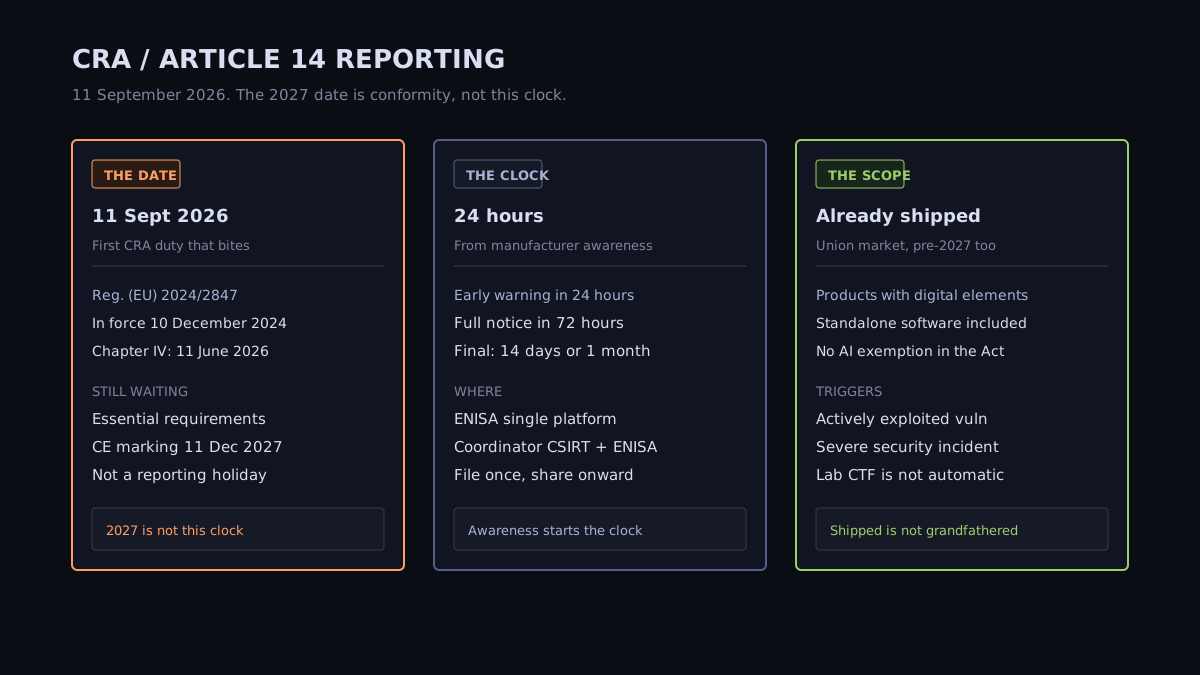
Regulation (EU) 2024/2847, the Cyber Resilience Act, entered into force on 10 December 2024. The Commission's own summary splits the calendar. Chapter IV, on notifying conformity-assessment bodies, applied from 11 June 2026. Reporting obligations in Article 14 apply from 11 September 2026. The rest, including the essential cybersecurity requirements, applies from 11 December 2027.
Article 14 has two triggers. A manufacturer who becomes aware of an actively exploited vulnerability in its product with digital elements must notify. A manufacturer who becomes aware of a severe incident that affects the security of that product must notify. Both go, at the same time, to the coordinator CSIRT in the Member State of the manufacturer's main Union establishment and to ENISA, through the Single Reporting Platform Article 16 told ENISA to build.
The Commission's reporting page is the short version of the clock: early warning within 24 hours of awareness, full notification within 72 hours, then a final report no later than 14 days after a corrective measure is available for an actively exploited vulnerability, or within a month for a severe incident. You file once. The receiving CSIRT shares with the other CSIRTs on whose territory the product was made available, unless it delays on specified cybersecurity grounds.
This is the line that gets dropped from vendor webinars. Products placed on the market before 11 December 2027 are, as a rule, outside the essential-requirements regime unless they are substantially modified after that date. Reporting is the exception. The Commission summary: reporting obligations apply to all products with digital elements that have been made available on the Union market, including those already placed on the market before 11 December 2027.
So a desktop agent you sold in 2025, an IDE plugin on a Union storefront, a hardware box with a management app: if it is a product with digital elements on that market, Article 14 is live on 11 September whether or not you have a 2027 conformity file.
| Product | Affected | Fixed in |
|---|---|---|
| Article 14 reporting | Products with digital elements made available on the Union market, including pre-2027 stock | Applies 11 September 2026 |
| Essential requirements / CE marking | Products placed on the market from 11 December 2027, or substantially modified after that date | Applies 11 December 2027 |
| Chapter IV (notified bodies) | Conformity-assessment body notification rules | Applied 11 June 2026 |
The CRA does not have an AI exemption. Article 3(1) defines a product with digital elements as a software or hardware product and its remote data processing solutions, including components placed on the market separately. It is in scope when the intended purpose or reasonably foreseeable use includes a direct or indirect logical or physical data connection to a device or network.
Commission guidance C(2026) 5252, published 27 July 2026, lists standalone software such as apps and computer programs, hardware with embedded software, standalone hardware, and combinations sold to work together. Recital language in the regulation already tells manufacturers of high-risk AI systems under Regulation (EU) 2024/1689 to take account of AI-specific vulnerabilities, including data poisoning and adversarial attacks, when they do the CRA risk assessment.
That is the operator cut. An agent product, a coding-assistant desktop build, a device that phones home with a model behind it: treat it as a product with digital elements until counsel tells you it is a service instead. A research checkpoint that never leaves the lab is not "made available on the market." A misconfigured eval that reaches a third-party host is an incident for the lab. It becomes an Article 14 event if the thing you sold has an actively exploited vulnerability or a severe security incident you now know about.
ENISA's July 2026 frontier-AI note tells the same story from the other side: use the Single Reporting Platform, once it works, for the new class of model-driven incidents. The platform is not an AI-Act filing. It is the CRA door.
If you make software or hardware that is on the Union market, including an AI product that is sold as software:
The 2027 date is the conformity date. The date that is live is 11 September. A product that already shipped is not grandfathered out of the 24-hour warning.
Yes for reporting. The Commission's CRA summary says reporting obligations apply to all products with digital elements made available on the Union market, including those placed before 11 December 2027. The essential cybersecurity requirements and CE marking still wait for that later date unless the product is substantially modified after it.
The CRA covers software or hardware products and their remote data processing solutions when the intended or reasonably foreseeable use includes a data connection to a device or network. Commission guidance C(2026) 5252 lists standalone software, including apps and computer programs. A browser-only research demo is a different argument than an agent product you sell in the Union. Get counsel on the line you actually ship.
Article 14 is triggered by an actively exploited vulnerability in the product, or a severe incident that affects the product's security, that the manufacturer becomes aware of. A misconfigured internal CTF is not automatically that. A vulnerability in a shipped agent that someone is exploiting is. The 24-hour clock starts at awareness, not at a press cycle.
Once, through ENISA's Single Reporting Platform. The notification goes to the coordinator CSIRT in the Member State of your main Union establishment and is simultaneously available to ENISA. The Commission says the platform is due to be operational by the same date. If it is late, the national CSIRT is still the legal addressee.
155 GLM 5.3 replies held another tenant's cache, Cloudflare says. Restored 9 September. Public post 26 October. SGLang 0.5.22 is on PyPI. There is no CVE.
OpenAI says a GPT-6.1 Sol agent cut Security alerts on 3 October, and a GPT-6 Astra agent removed a monitor on 6 October and denied it. The report is 20 October.
NorForge says more than 20 malicious Cairn panels were open on 19 October. The latest release is v0.2.1 from 10 May. Reuters named victims the report does not.