155 GLM Replies Crossed Tenants. There Is No CVE.
155 GLM 5.3 replies held another tenant's cache, Cloudflare says. Restored 9 September. Public post 26 October. SGLang 0.5.22 is on PyPI. There is no CVE.
Google patched CVE-2026-85046 in Chrome 152.0.7977.82 on 3 September and said an exploit is in the wild. CISA added it to KEV. Edge, Opera, and Electron share V8.
CVE-2026-85046 is type confusion in V8. Google patched Chrome 152.0.7977.82 on 3 September and said an exploit exists in the wild. A crafted page runs code inside the renderer sandbox. CISA listed it as KEV on 4 September, due 18 September. Edge, Brave, and Electron inherit the same engine on their own update clocks.
The Hacker News has the headline: a Chrome V8 zero-day, exploited in the wild, runs code inside the sandbox. That is the news. The operator fact is in Google's 3 September Stable note. Chrome before 152.0.7977.82 is open. A Chrome relaunch does not close Edge, and it does not close an Electron app that still ships last month's engine.
High Type confusion in V8, Chromium High, CISA CVSS 8.8. Google says an exploit exists in the wild. Code runs in the renderer sandbox until a second bug takes it further.
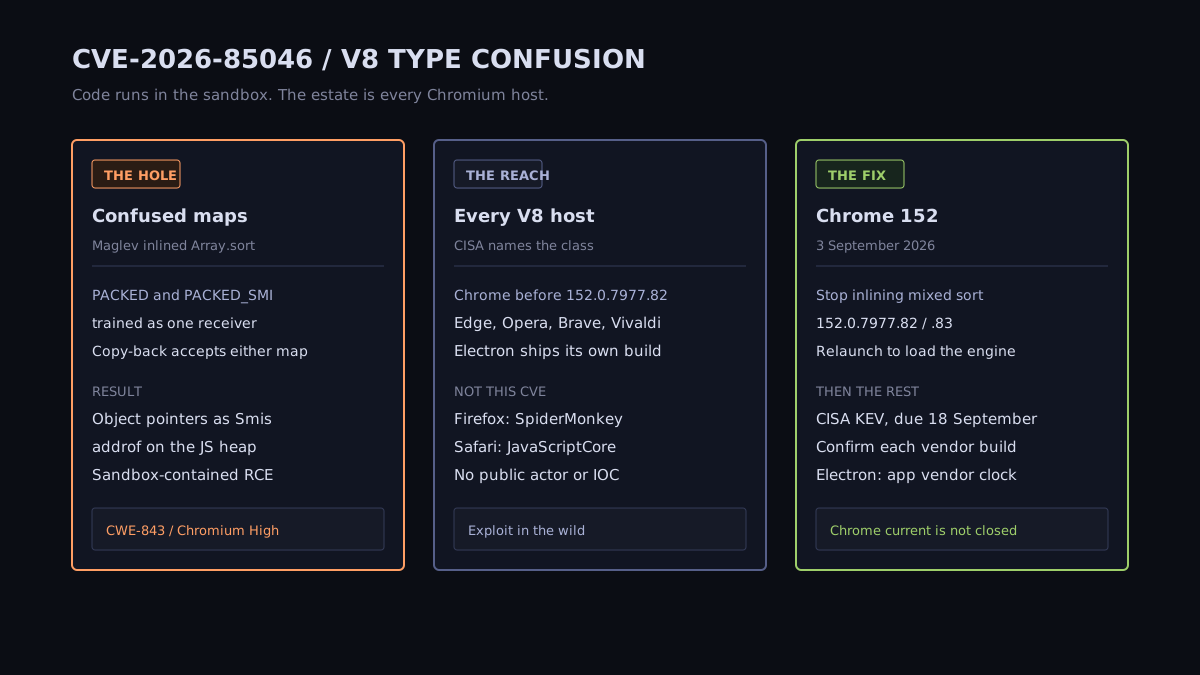
The Stable channel moved to 152.0.7977.82/.83 on Windows and Mac and 152.0.7977.82 on Linux on Thursday, 3 September. Twelve security bugs went out in that build. One of them is CVE-2026-85046: type confusion in V8, Chromium severity High, CWE-843. Google's sentence is the one that matters: the company is aware that an exploit for CVE-2026-85046 exists in the wild.
The researcher is Salvatore Gulizia (Serotav). He reported it on 4 August. Google paid $1,000. Chromium issue 542403045 is the tracker. Restricted disclosure is still in force on Google's side; the public technical record is Gulizia's own write-up, not a TAG or GTIG campaign note.
Help Net Security counts this as the sixth Chrome zero-day Google has patched in 2026, after CVE-2026-2441, CVE-2026-3909, CVE-2026-3910, CVE-2026-5281, and CVE-2026-11645. That is a cadence fact, not a victim count. Google has not named an actor, a target set, or a payload.
We are not reprinting the trigger. The class is enough, and it is already public.
Gulizia's write-up places the defect in Maglev's TryReduceArrayPrototypeSort (TurboFan had the same class). Maglev will inline a small Array.prototype.sort as an insertion sort when the receiver has known packed maps. It trained on both PACKED_SMI_ELEMENTS and PACKED_ELEMENTS. Those two layouts share tagged FixedArray slots, so the compiler accepted them together.
The copy-back after the sort checks that the receiver's map is still one of the maps it saw before the loop. It does not require the map to be unchanged. A comparator that replaces every element can migrate the receiver to the Smi-packed map while the temporary copy still holds object pointers. After copy-back, the array's map says "these are small integers" and the slots still hold tagged pointers. That is the type confusion.
Gulizia showed that this is enough to leak heap offsets, an addrof primitive, and, with a separate write-barrier skip, to build a fake object. He then chained a known sandbox escape to flag v8CTF. That second bug is not CVE-2026-85046. Google's advisory stops at the sandbox. So should the incident ticket, unless you have evidence of a chain.
The vendor fix is one line of policy: do not inline Array.prototype.sort on mixed element kinds. Gulizia points at V8 commit e0562d87ad9c17042b581582c99237d798572e67.
| Product | Affected | Fixed in |
|---|---|---|
| Google Chrome (Windows, macOS) | prior to 152.0.7977.82 | 152.0.7977.82 or 152.0.7977.83 |
| Google Chrome (Linux) | prior to 152.0.7977.82 | 152.0.7977.82 |
| Other Chromium browsers (Edge, Opera, Brave, Vivaldi) | any build that has not ingested the V8 fix | vendor Chromium update; confirm engine build |
| Electron and other embedded Chromium hosts | apps shipping V8 from Chrome < 152.0.7977.82 | app vendor update, not the system Chrome |
CISA's KEV row is titled "Google Chromium V8 Type Confusion Vulnerability." The required action is vendor mitigations under BOD 26-04. The catalog text is explicit that the hole can affect multiple browsers that use Chromium, including Chrome, Microsoft Edge, and Opera. Ransomware use is listed as Unknown. Forensic triage is not required.
That is why a green Chrome About page is not a closed ticket. Edge, Brave, Opera, and Vivaldi fork Chromium and ship V8 on their own calendars. Firefox and Safari do not; they are out of scope for this CVE.
The quieter remainder is everything that embeds Chromium and does not call itself a browser: Electron chat clients, IDEs, note apps, and the desktop shells a lot of AI tools now ship in. Those binaries carry their own Chrome/ version. They update when the app vendor ships, not when Google does. A fleet that force-updated Chrome this week can still be running the vulnerable engine inside a sidecar.
If you run browsers or Chromium-hosted apps:
chrome://settings/help should show 152.0.7977.82 or later. Relaunch. For managed fleets, force the Stable package and verify the version on the endpoint, not the policy that was pushed.Chrome/ and Electron/. Anything still advertising a Chrome build below 152.0.7977.82 is this CVE until the app vendor ships.The 8.8 is the hole. The wild exploit is why it jumped the queue. The missed ticket is the Chromium host you did not relaunch.
You are done for Google Chrome once About Chrome shows 152.0.7977.82 or later and the browser has relaunched. You are not done for the estate. CISA's KEV entry says the same V8 hole can affect other Chromium browsers, and it names Edge and Opera. Electron apps update on the app maker's clock, not Chrome's.
Not by itself. Google's advisory is code execution inside the renderer sandbox. Gulizia's public write-up says he chained a separate n-day sandbox escape to flag v8CTF. That chain is research. Google has not said the in-the-wild exploit escaped the sandbox.
No. CVE-2026-85046 is a V8 compiler bug. Firefox runs SpiderMonkey. Safari runs JavaScriptCore. Those engines have their own defects, but they do not inherit this one. Chromium forks do.
Google withheld campaign detail while the update rolled out. There is no published IOC list, no actor name, and no ransomware tag (CISA lists that field as Unknown). The actionable signal is the version: any Chrome before 152.0.7977.82, and any other Chromium host that has not ingested the same V8 fix.
155 GLM 5.3 replies held another tenant's cache, Cloudflare says. Restored 9 September. Public post 26 October. SGLang 0.5.22 is on PyPI. There is no CVE.
Qwen3.8-Flash-Next tried to upload after its reasoning said no tools. Cohere's sandbox blocked it. Under one eval call in 100,000. No CVE and no weight hash.
A Downloads instruction file sent Codex toward function-color. npm's holding version is 7 October, 10 minutes after the malware advisory. There is no agent CVE.