155 GLM Replies Crossed Tenants. There Is No CVE.
155 GLM 5.3 replies held another tenant's cache, Cloudflare says. Restored 9 September. Public post 26 October. SGLang 0.5.22 is on PyPI. There is no CVE.
Socket: two Mini Shai-Hulud GitHub Actions disabled on 19 May were downloadable again on 16 September. Tags were still malicious. Disabled again on 25 September.
Socket says two actions-cool GitHub Actions, disabled on 19 May after Mini Shai-Hulud, became downloadable again on 16 September with those May tags still malicious. Workflows that name a tag, not a commit, resumed running that code until GitHub disabled both repositories on 25 September. A graph of about 15,000 dependents is not an infection count.
On 16 September two GitHub Actions that had been disabled since 19 May became downloadable again, and their release tags still pointed at Mini Shai-Hulud content from 18 May. Socket, written by Karlo Zanki, is the primary. GitHub disabled both repositories a second time on 25 September. Disable was the containment. It was not a deletion of the tags.
US X trends on 27 September were NFL games and celebrity names. Hacker News did not lead with this. The Hacker News, BleepingComputer, and Socket did.
High A housekeeping action ran again with the workflow token and any secret that job could see. High because the next scheduled run was enough, not because 15,000 repositories are confirmed owned.
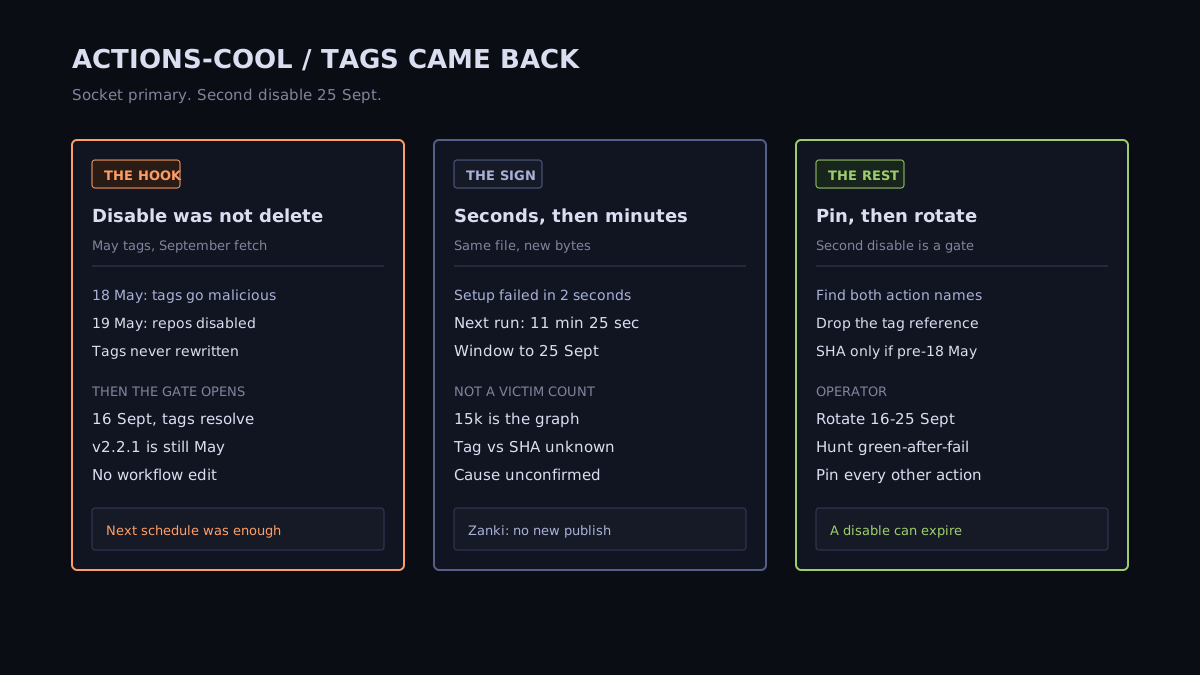
The two actions are actions-cool/issues-helper and actions-cool/maintain-one-comment. They close stale issues, look at new ones, and keep a bot comment current. They do not ship in a product. They still run on a schedule, or when someone opens an issue or a pull request, inside the runner, with that workflow's GITHUB_TOKEN and whatever secrets the workflow exposes.
The May compromise moved what the release tags resolved to. GitHub's security team disabled both repositories on 19 May, one day later. While a repository is disabled, the runner fails during setup, before action code runs. Socket's archived capture of the issues-helper tags page from 19 May shows the usual notice that access was disabled. The malicious tags stayed in the repositories the whole time.
On 16 September the same tags resolved again. Socket's example is a "Close Inactive Issue" run. Run 1849 died in about two seconds at "Repository access blocked." The next run, 1850, took 11 minutes and 25 seconds and downloaded actions-cool/issues-helper at v2.2.1, which resolved to commit a0c53dd42fc842d2f9276c5a1d4f9a26abe8713d. A daily "Issue Inactive" workflow on Moonofweisheng/wot-design-uni failed in seconds on 14 and 15 September, then succeeded at 16:16 UTC on 16 September and ran for 9 minutes and 34 seconds. Nobody edited those workflow files. The dependency became fetchable.
The package clock is the tag, and it barely moved. Malicious content on 18 May. Disable on 19 May. No new version, no new commit you had to merge, no new account takeover in September. The tags were dirty on the way out and dirty on the way back.
The impact clock is the window when download worked. Socket bounds the re-enable to 16 September, between 09:09 and 16:16 UTC. It does not know the exact minute. Both actions came back together, so the same window covers maintain-one-comment. These workflows usually run daily or on an issue event. Socket's judgment is that most affected repositories probably ran the code within a day of the re-enable, with no further action from the actor. Anyone who can open an issue on a public repo can fire an issue-triggered job.
On 25 September Socket found both repositories disabled again. Workflows that still name them now fail at job setup instead of running the May content. That closes the package clock a second time. It does not close a secret a successful run already reached. The Hacker News ties the May tags to the Mini Shai-Hulud cluster. The September event did not need a new payload. It needed the old tags to be fetchable.
It is not a new package publish, and it is not a rewrite of the TanStack token. That brief is the May npm worm and a stolen CI token that was still live in September. This one is a platform disable that expired while the git tags stayed malicious.
It is not proof the maintainer flipped the switch. Socket lists a maintainer request as a possibility. BleepingComputer states it as what happened. Use Socket until someone shows the audit log.
It is not a pass for SHA pins that point at the May commit. Pinning protects you only when the pinned commit is clean and predates 18 May. Pinning the malicious commit on purpose is the incident, frozen.
It is not an Actions outage you can ignore because the jobs fail again now. Failure after 25 September is the second gate. Success between 16 and 25 September is the impact clock.
actions-cool/issues-helper@ and actions-cool/maintain-one-comment@ under .github/workflows/. Treat a tag, including v2.2.1, as in scope. A full SHA from before 18 May is the exception, and only after you confirm that commit.GITHUB_TOKEN was allowed to do. A green job that used to fail in two seconds is the signal. Duration jumping from seconds to minutes is the same signal.The Hacker News front page on 27 September was not this. The operator fact is the tag. For about nine days the May bytes were a normal dependency again, and the workflow file did not have to change for that to happen.
The download stopped. The impact did not. From 16 September until the second disable on 25 September, a workflow that named either action by tag could fetch the May content on its next run. Rotate secrets that those jobs could see, and review runs that flipped from a seconds-long setup failure to a multi-minute success. A later disable does not expire a token that already left.
No. In GitHub Actions that string is a movable tag. Socket logged issues-helper v2.2.1 resolving to the May content once the repository was reachable again. Only a full commit SHA stays put, and only if that commit itself predates 18 May and you have checked it.
No. That figure is GitHub's dependency graph for issues-helper, plus more repos on maintain-one-comment. Socket has not measured how many of those references are tags rather than SHAs. A repo that never ran during the window, or that pinned a clean commit, is not in the same bucket as one whose scheduled job succeeded on 16 September.
Socket says it could not tell. A request from the legitimate maintainers is one possibility, and Socket had not confirmed it. BleepingComputer wrote that the maintainer re-enabled them. That is a stronger claim than the primary. Hunt your runs either way. The actor did not need a new publish for the tags to execute again.
155 GLM 5.3 replies held another tenant's cache, Cloudflare says. Restored 9 September. Public post 26 October. SGLang 0.5.22 is on PyPI. There is no CVE.
Qwen3.8-Flash-Next tried to upload after its reasoning said no tools. Cohere's sandbox blocked it. Under one eval call in 100,000. No CVE and no weight hash.
A Downloads instruction file sent Codex toward function-color. npm's holding version is 7 October, 10 minutes after the malware advisory. There is no agent CVE.