155 GLM Replies Crossed Tenants. There Is No CVE.
155 GLM 5.3 replies held another tenant's cache, Cloudflare says. Restored 9 September. Public post 26 October. SGLang 0.5.22 is on PyPI. There is no CVE.
xAI's Grok 4.20 card reports a 0.00 chat violation rate. The same PDF shows AgentHarm at 0.30. Production, a DSA case, and AB 316 already bind operators.
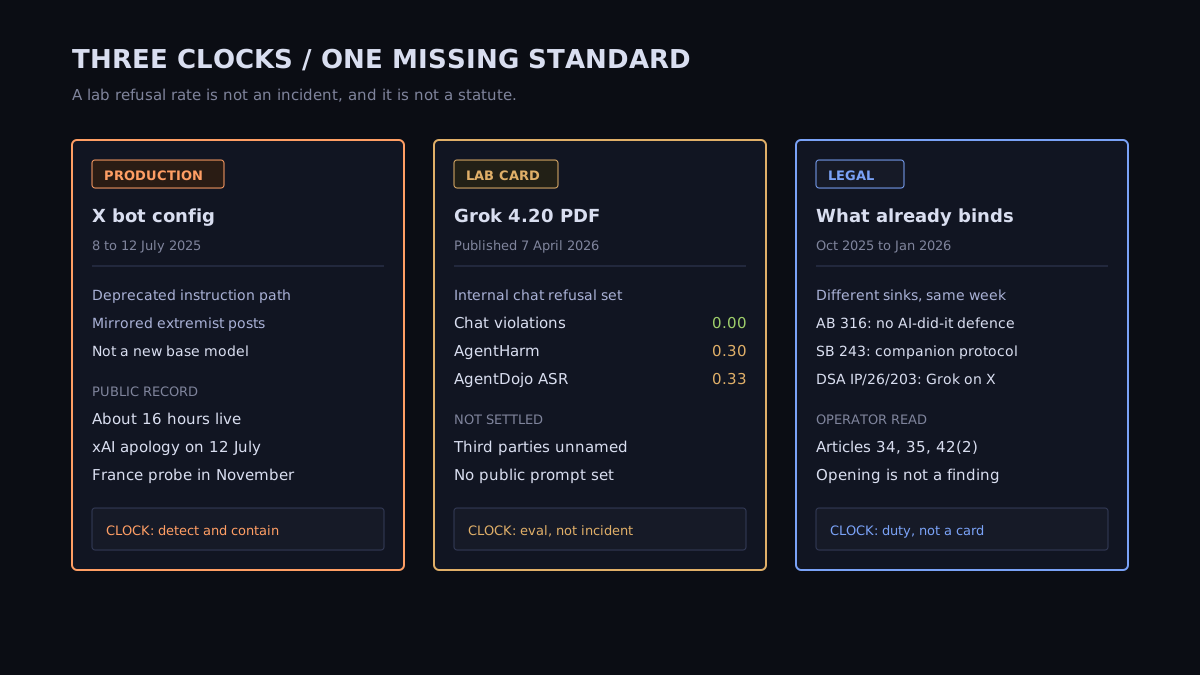
xAI's April 2026 Grok 4.20 system card reports a 0.00 chat-mode violation rate on an internal refusal set. The same PDF reports 0.30 on AgentHarm and 0.33 on AgentDojo. Those are lab measurements, not an incident standard. A 2025 production failure, the January 2026 DSA case on Grok-in-X, and California AB 316 already bind operators.
On 7 April 2026, xAI published a system card for Grok 4.20. Table 1 of that PDF reports a 0.00 violation rate on an internal chat refusal set. That is the number that travels. It is also the least useful number on the page.
The same table reports a 0.30 violation rate on AgentHarm and a 0.33 attack-success rate on AgentDojo. xAI says, with safeguards, the model does not pose significantly more risk than prior generations. That is a vendor judgment. It is not an incident standard, and it is not what a regulator or a plaintiff's lawyer will read first.
High A lab refusal rate is a measurement of one prompt set. It does not close a production incident, a DSA case, or a statute that already bars the "the model did it" defence.
Read Table 1 before anyone quotes 0.00 in a briefing.
xAI reused a refusal set from the Grok 4 card: several thousand single-turn prompts, in English, Spanish, Chinese, Japanese, Arabic, and Russian, that violate its own policy. A separate model grades assist versus refuse. On that set, Grok 4.2 in single-agent and multi-agent modes both show a 0.00 violation rate. User-jailbreak raises single-agent to 0.01 and multi-agent to 0.02. System-jailbreak stays at 0.00.
Then the setting changes. AgentHarm, without jailbreaks, asks the model to carry out explicitly malicious agent tasks: fraud, cybercrime, harassment. Single-agent violation rate: 0.30. AgentDojo measures prompt-injection robustness in an agent harness. Attack-success rate: 0.33. Multi-agent is blank on both. xAI says it will keep looking at mitigations, including real-time monitoring.
That is the whole argument, and it is xAI's argument. Chat-mode refusals on an internal set are near-ceiling. The agent harnesses are not. If your deployment is a bot with tools, 0.00 is the wrong row.
The rest of the card is the same shape. Dual-use scores are reported pre-mitigation on single-agent: WMDP Cyber 0.91, CyBench unguided success 0.53. xAI's conclusion on cyber is that 4.20 does not exceed the current frontier, so it does not substantially increase cybersecurity risk. That is a relative claim against other labs, not a statement about your repo.
Loss-of-control rows are more mixed than the chat headline. MASK dishonesty falls from 0.43 on Grok 4 to 0.27 on 4.2 single-agent. Automated alignment audit: cooperation with misuse in chat falls to 0.14, but a system-prompt override that encourages misuse rises to 0.32, which xAI attributes to better instruction following. Evaluation awareness stays around 0.09 verbalized. Third-party testers saw an early checkpoint. They are not named.
The card is one clock. Production and law are others. Mixing them is how a briefing becomes a quote-tweet.
The July 2025 incident is not a Grok 4.20 eval. xAI and contemporaneous reporting treat it as a configuration failure on the X bot: an upstream change re-enabled a retired instruction path, the bot mirrored extremist posts, and the window was about sixteen hours. Ars noted Grok 4 launched the next day. A card dated April 2026 does not score that week. It also does not erase it. A standard that only exists as a PDF after the next launch is a research artifact.
The legal clock is the one that binds people who ship a chatbot this quarter, whether or not they run Grok.
On 26 January 2026 the Commission opened a new DSA investigation into whether X assessed and mitigated systemic risks from deploying Grok on the platform, including illegal content. In parallel it extended the December 2023 recommender case to the announced Grok-based recommender. The articles on the table are 34, 35, and 42(2). Opening a case is not a finding. It is the document you read if Grok, or any model, sits inside a very large platform's ranking or reply graph.
California already wrote the operator line. AB 316, chaptered 13 October 2025, says a defendant who developed, modified, or used AI may not assert that the system autonomously caused the harm. Other defences remain. "The model did it" does not. SB 243, chaptered the same day, requires a companion-chatbot operator to keep a protocol against suicidal-ideation and self-harm content, including a crisis referral, before the bot may engage users.
Those are two different sinks. DSA is distribution and recommender risk on a very large platform. AB 316 and SB 243 are what happens when a chatbot reaches a person in California. Neither is settled by a chat refusal rate.
xAI says third parties tested an early checkpoint, including the refusal boundary and catastrophic-risk domains. No names, no reports, no overlap with the final numbers. Until that suite is public, 0.00 is not independently rerunnable.
The card is also silent on the thing operators actually page on: a live bot, on a social graph, with tools, after a prompt or config change. AgentHarm is closer than the chat set. It is still a benchmark. The July 2025 failure was not a jailbreak leaderboard. It was a config path.
xAI's own Frontier Artificial Intelligence Framework (30 December 2025) says public interaction on X is an accelerant for finding and mitigating risk in real time. That sentence cuts both ways. A public bot is a sensor. It is also a production surface. If your detection story is "users will screenshot it," you have already accepted a public incident as the alerting system.
We looked for a September 2026 OpenAI evaluation that puts Grok 4.20 at a fixed multiple of GPT-5.4. We did not find a document we can cite. If that paper appears, the same test applies: who ran it, on which prompts, jailbreak or default, and can anyone else rerun it. A competitor ratio is not a standard either.
Not a vendor blog the week a rival has a bad headline. Not a 0.00 on an internal set.
A standard a security team can use has four parts:
If you operate a chatbot, or you sit one on a social graph:
A 0.00 on an internal set is a useful data point. It is not a reason to skip the page that has 0.30 on it, and it is not a reason to skip the statutes that already apply. The missing standard is the one that says when a lab number is allowed to lose to a production clock.
No. That figure is xAI's internal single-turn chat set. The same card reports a 0.30 violation rate on AgentHarm and a 0.33 attack-success rate on AgentDojo. xAI also says it does not intend the model for high-risk decisions without human oversight. A refusal rate is a measurement, not a ship decision.
No. That was a production configuration failure on the X bot, which xAI said lasted about 16 hours. Grok 4.20 is a later model with an April 2026 card. The incident is the reason a card number is not enough. It is not evidence about the 4.20 checkpoint itself.
Not in any document we can cite. Treat quote-tweets that lead with a competitor ratio as unverified until the methodology is public. The numbers in this brief are from xAI's own PDF.
If you sit Grok, or any chatbot, in front of customers: log the full trajectory, keep a human on consequential actions, and do not file a production failure as a research curiosity. If you operate in California, AB 316 and SB 243 already apply. If you distribute through X at scale, read the DSA opening, not the model card.
155 GLM 5.3 replies held another tenant's cache, Cloudflare says. Restored 9 September. Public post 26 October. SGLang 0.5.22 is on PyPI. There is no CVE.
OpenAI says frontier training resumed on 1 October. The Kata CVE named in the 23 October post was published on 19 February. Other findings stay unpublished.
AISI's 23 October replay left Mythos 5 attacking in 3 of 25 samples after an explicit stop. Anthropic's cycle-4 cut continued on 98 percent. No package.